The search for the perfect home is often a quest for a lifestyle. Today, that lifestyle prioritizes fluidity, natural light, and efficiency—qualities perfectly embodied by Contemporary House Plans. Far from being a rigid style, contemporary design is a constantly evolving architectural movement defined by the “here and now.” It captures the latest trends in technology, sustainability, and human-centric living, making it the most sought-after design for new custom homes.
If you are looking to build a forward-thinking, energy-efficient, and supremely functional home, understanding the core principles of contemporary architecture is your first step.
Contemporary vs. Modern: Understanding the Core Difference
Before diving into the features, it’s crucial to clarify the most common confusion in architectural terms:
- Modern House Plans refer to a specific, historical style rooted in the early to mid-20th century (think 1920s to 1950s—the influence of architects like Frank Lloyd Wright and the Bauhaus movement). Modern design is fix, characterize by strict geometric forms, horizontal lines, and historical allegiance to its minimalist origins.
- Contemporary House Plans mean “of the moment.” It is an ever-changing style that borrows elements from Modernism but is not bound by its rules. Contemporary design is more playful, embracing asymmetry, curves, mixed materials, and the very latest in building technology and lifestyle trends. It’s a dynamic, adaptable, and innovative aesthetic.
Defining Features of the Contemporary Exterior
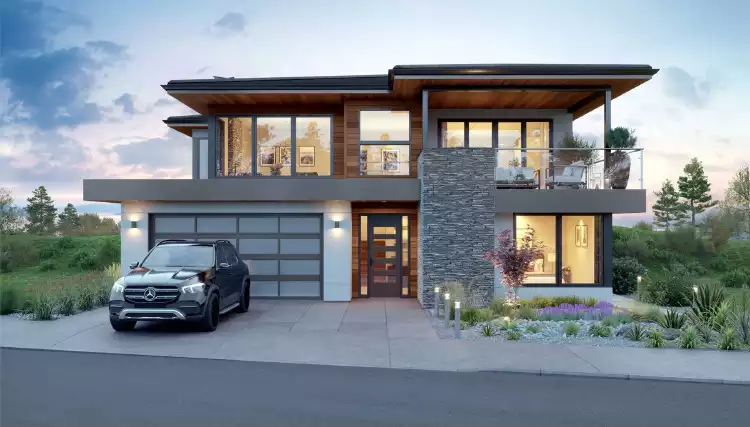
Contemporary architecture makes a strong, minimalist statement from the street, focusing on form, texture, and light rather than ornamentation.
- Asymmetrical & Geometric Forms: Contemporary facades often feature bold, deliberate asymmetry. Expect unexpected angles, striking geometric masses, and sometimes even curved elements that break away from the boxy shapes of traditional Modernism.
- Flat or Low-Pitched Rooflines: These clean roof profiles eliminate visual clutter and emphasize the home’s strong horizontal lines. Flat roofs are common, not only for their aesthetic but for their practicality in accommodating solar panels and rooftop decks.
- Mixed Material Palettes: Texture is key. Contemporary homes eschew uniform siding in favor of a sophisticated blend of natural and industrial materials: expansive glass, raw concrete, steel accents, stained or natural wood cladding, and natural stone. This mix provides visual depth without the need for traditional decoration.
- Expansive Window Walls: Perhaps the most defining feature is the strategic use of oversized windows, often floor-to-ceiling glass. These are place not just for light, but to frame specific outdoor views, dramatically blurring the line between the interior and the surrounding landscape.
The Interior Philosophy: Openness and Fluidity
Contemporary interiors are designed for the way we live now, prioritizing multipurpose zones and a connection to nature.
- Open-Concept Living Areas: The traditional separation of kitchen, dining, and living rooms is largely eliminated. Contemporary plans feature seamless, flowing spaces, often distinguished by ceiling changes, lighting zones, or strategic furniture placement rather than walls. This promotes natural light distribution and social interaction.
- Minimalist Aesthetic, Maximum Function: The “less is more” ethos dictates clean lines, integrated appliances, and a distinct lack of clutter. Functionality is often hidden: expect deep built-in storage, sleek handle-less cabinetry, and hidden doors that maintain the smooth visual plane.
- Soaring and Vaulted Ceilings: High ceilings and expansive two-story volumes are frequently used to enhance the feeling of space and airiness, emphasizing the abundant natural light filtering in from above.
- Neutral & Contrasting Color Schemes: Interiors favor a cool, neutral palette—shades of white, grey, taupe, and black. Color is typically introduced through artwork, soft furnishings, or a single feature wall, adding customizable “pops” of personality without compromising the clean, architectural background.
The Long-Term Benefit: Sustainability and Technology
Beyond aesthetics, contemporary house plans are fundamentally smarter and more responsible than their historical counterparts. This is where the style truly aligns with the demands of 21st-century living:
- Eco-Conscious Construction: Contemporary design strongly favors sustainability. Plans often integrate energy-efficient features from the blueprint stage, including superior insulation, high-performance windows, geothermal heating readiness, and optimized positioning to maximize passive solar heating and natural cross-ventilation.
- Seamless Indoor-Outdoor Living: Large sliding glass doors, covered patios, and integrated outdoor kitchens effectively extend the living space. The design ensures a seamless transition, allowing the home to feel larger and fostering a vital connection to the outdoor environment.
- Smart Home Integration: From embedded conduits for automated systems to designated tech zones, contemporary homes are built to be technology-ready. This includes planning for advanced security, automated lighting, climate control, and future-proof wiring.
Conclusion
Contemporary house plans are the ultimate expression of current design philosophy: adaptable, light-filled, and efficient. They offer a dynamic canvas for the homeowner who values clean aesthetics, sustainable performance, and the seamless integration of technology. Building a contemporary home is an investment not just in a structure, but in a future-proof lifestyle that maximizes comfort, natural beauty, and utility. It is, quite simply, the architecture of tomorrow, built today.